
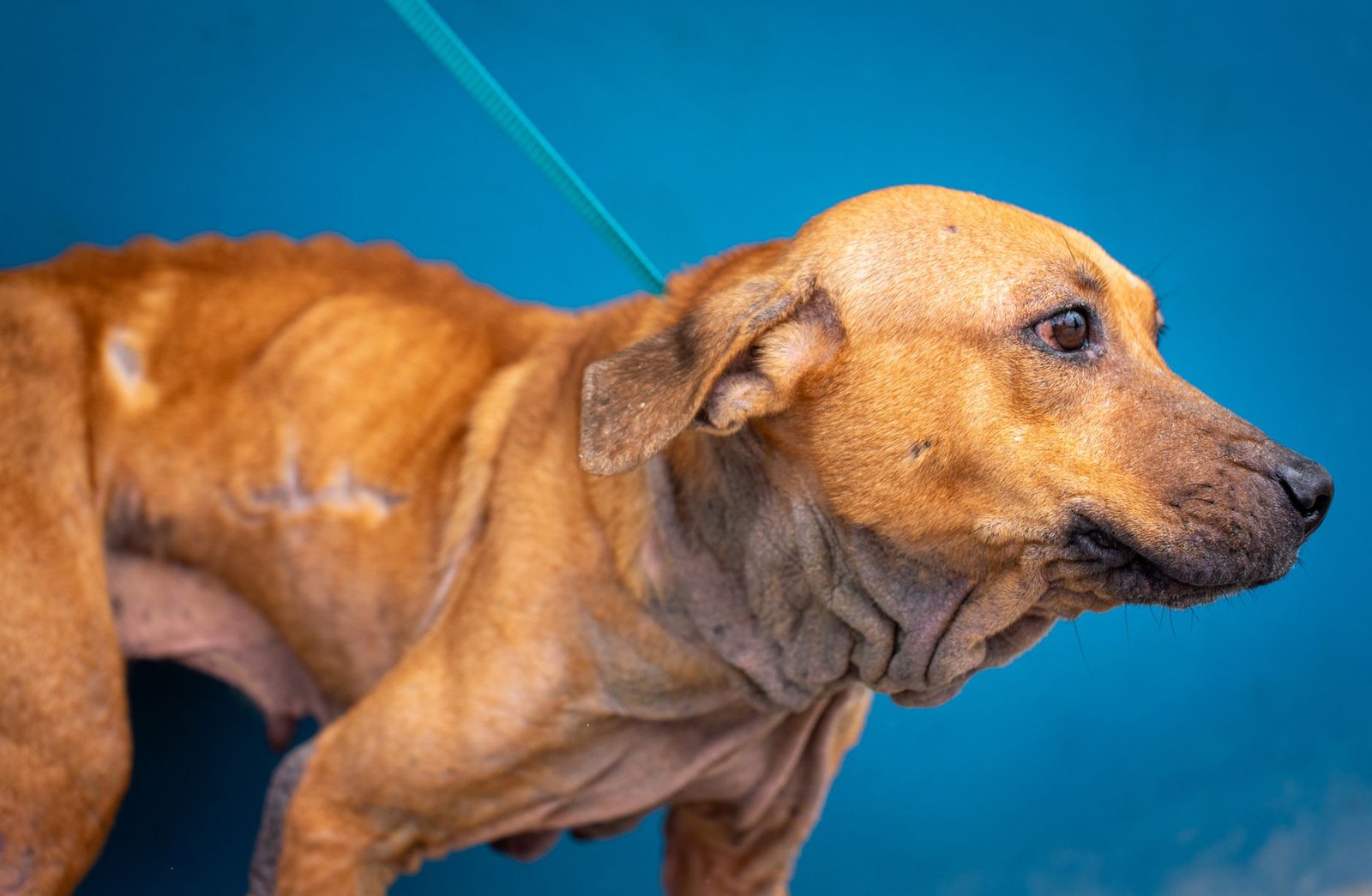
It is the most believable story in the world. The dog is getting older, the walks are shorter in the rain, and they have put on weight and lost their spark. Everyone involved blames November and age. In a fair number of middle-aged dogs there is a different answer, and it is straightforward to confirm.
What an underactive thyroid does
The thyroid sets the pace of the whole body. When it slows — hypothyroidism — everything slows with it, and the changes arrive gradually enough that each one gets absorbed into normal.
- Weight gain without eating more. This is the one that convinces owners something is off, because the food has not changed.
- Low energy. Sleeping more, less interested in the walk, no longer first to the door.
- Seeking out heat. Pressed against the heat vent, under a blanket, reluctant to go out in the cold when they never minded before.
- Coat changes. Thinning along the flanks and the trunk, a dull dry coat, and in some dogs a thin or bald tail. Hair that does not grow back after clipping is a classic.
- Skin and ears that keep flaring. Recurrent ear problems or skin infections that respond and then come right back are a common way this is first spotted.
- A puffy, slightly mournful face, from thickening of the skin around the eyes and forehead.
- Sometimes a slow heart rate, and a reluctance to exercise that looks like a joint problem.
It turns up most often in middle-aged dogs, and it is more common in some breeds than others. Golden Retrievers, Doberman Pinschers, Boxers, Irish Setters, Cocker Spaniels and Dachshunds are all over-represented, though no breed is exempt and plenty of crossbreeds are affected.
One thing to clear up, because it causes constant confusion: this is a dog problem. Cats very rarely develop an underactive thyroid on their own. What cats get is the opposite — an overactive one — and that presents as a thin, hungry, restless cat. If you have a cat losing weight while eating well, that is a different conversation and also worth having.
How it is confirmed, and why one number is not enough
The blood test is simple and widely available. Interpreting it is where the care goes in.
The complication is that almost any other illness in the body pushes thyroid readings down without the thyroid being at fault. A dog who is unwell for an entirely separate reason can produce a low result and get labelled with a thyroid problem they do not have. That is why we look at more than one thyroid value together, alongside a general blood panel, the physical examination and the history you give us. The picture has to hang together.
Our medical services cover the consultation and the interpretation, and in-house laboratory work gives us the general panel while you are here rather than days later. Because the signs creep in so slowly, a wellness visit with baseline bloodwork while a dog is well is what makes a later result readable instead of a guess.
The good part
This is one of the more satisfying things we find, because it responds well. Management is a replacement given by mouth at home, every day for the rest of the dog’s life. How often it is given is something we set for your individual dog and adjust at the rechecks. It is inexpensive and dogs take it easily.
What owners should expect is a staggered recovery. The energy and the appetite usually shift within a couple of weeks, which is the point at which people realize how little energy the dog had had. The weight follows over the next month to three, with the food under control. The coat is last and takes several months, sometimes looking briefly worse before it looks better as the old hair comes out. Nobody should judge progress by the coat at the six-week mark.
The rechecks matter. Getting the level right is not a single calculation, and a dog who is over-replaced has their own set of problems. Expect us to want blood again a few weeks after starting, and then periodically.
Our hours
We are open Monday to Friday from 8:00 am to 1:00 am and Saturday and Sunday from 9:00 am to 5:00 pm. We are closed on statutory holidays. Being open until 1:00 am on weekdays means a lot of things that would otherwise become an overnight emergency can be seen the same evening, which is unusual for North Vancouver.
Nothing in this article is urgent, and a thyroid test is an appointment rather than a dash. If your pet is collapsed, struggling to breathe, seizing or in obvious pain when we are closed, call VCA Canada Vancouver Animal Emergency and Referral Centre at (604) 879-3737, which is the after-hours hospital we refer to.
Common questions
My dog is overweight. Is it worth testing before putting them on a diet?
Often yes, particularly if the weight went on without the food changing, or if a sensible diet has not shifted it. Dieting a dog whose thyroid is the problem is frustrating for everybody.
Could this be why the ear infections keep coming back?
It can be. Recurrent skin and ear problems with no obvious cause are a recognized way an underactive thyroid announces itself, and for some dogs the flare-ups settle a great deal once the thyroid is sorted out. In others there is an allergy underneath as well, and both need handling.
Is it hereditary? Should I worry about the litter?
There is a breed predisposition, so it runs in some lines. It is not a reason to panic about siblings, but it is worth mentioning to anyone who has a related dog.
Will my dog need testing forever?
Periodic rechecks, yes, for life. They are quick and they are what keeps the level correct as the dog ages and their weight changes.
My dog has all these signs but the test was normal. Now what?
Usually it points somewhere else, which is useful information rather than a dead end, because weight gain, lethargy and coat change have several other causes. Occasionally a borderline result is worth repeating, or worth adding a second thyroid value to, before we move on.
Speak to the team at Norgate Animal Hospital
If your middle-aged dog has gained weight, lost their enthusiasm and thinned out across the coat, book a visit and ask us about testing for hypothyroidism. It is one blood sample and it is worth knowing either way.
Published by the team at Norgate Animal Hospital.
This article is educational in nature and is not a replacement for hands-on assessment of your own pet by a veterinarian.
Norgate Animal Hospital
1435 Marine Drive, North Vancouver, BC V7P 1T5
Phone: (604) 980-2222
Hours: Monday to Friday 8:00 am to 1:00 am; Saturday and Sunday 9:00 am to 5:00 pm; closed statutory holidays